

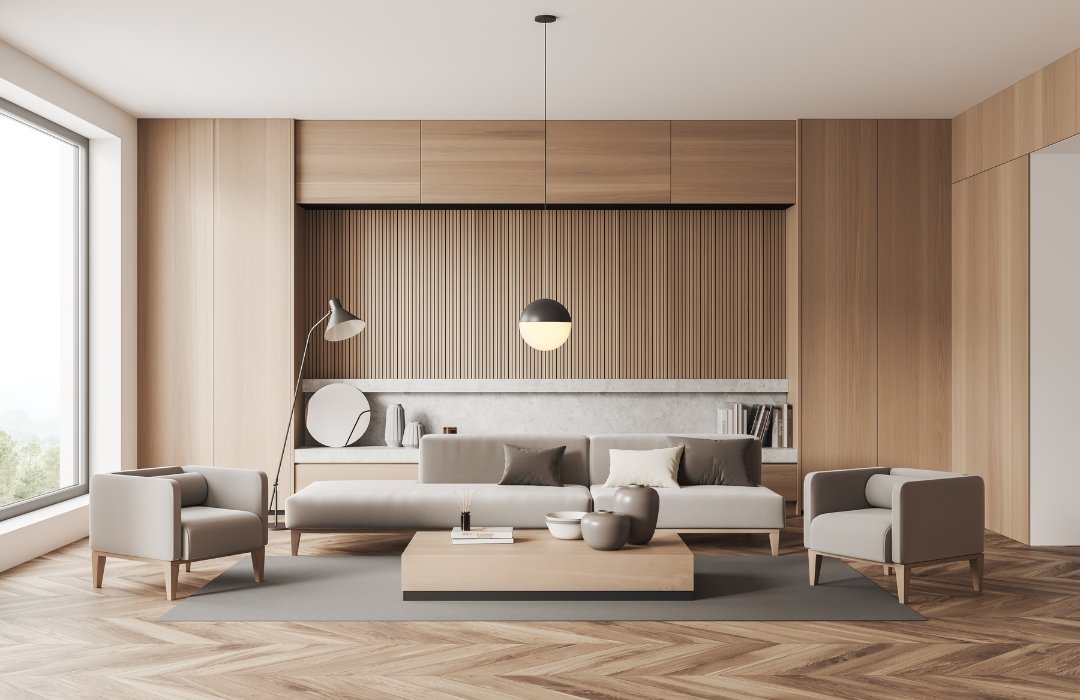
The Unsung Hero of High-End Design
For too long, plywood has been relegated to subflooring and construction staging. Yet, in the hands of modern architects and designers, it is a versatile material capable of achieving some of the most sophisticated and durable interior finishes available today.
The secret lies not in the core wood, but in the advanced finishing techniques—specifically, the use of high-quality Film-Faced and Laminated treatments. These engineered finishes transform basic plywood into visually stunning, maintenance-free surfaces perfect for everything from minimalist cabinetry to commercial feature walls.
1. Film-Faced Plywood: The Minimalist’s Secret Weapon
Film-faced plywood is traditionally known for its use in concrete formwork, where it provides a smooth, reusable casting surface. However, its properties make it an ideal—and highly durable—material for high-traffic interior applications.
The Aesthetic Advantage
The film is typically a Phenolic resin overlay that is heat-pressed onto the surface. The result is a uniformly smooth, hard, and often glossy or matte surface that delivers a few key design benefits:
- Seamless Finish: It provides a flawless, consistent texture that is perfect for minimalist, Scandinavian, or industrial-chic designs where uniformity is paramount.
- Color Versatility: While often seen in black or brown, the film can come in various colors, allowing designers to specify bold, continuous color blocks without the need for additional painting or sealing.
The Durability Advantage
The Phenolic film layer acts as a super-durable barrier, making the wood resistant to:
- Moisture: Ideal for kitchen backsplashes, laundry rooms, or commercial bar areas.
- Abrasion: Perfect for high-wear areas like retail shelving and reception desks.
2. Laminated Plywood: Achieving Perfect Texture and Pattern
For projects requiring intricate grain patterns, solid color blocks, or specific tactile textures, laminated plywood provides the ideal solution. Lamination involves bonding a high-pressure laminate (HPL) or veneer onto the surface.
- The Look: High-quality laminated plywood allows designers to achieve the look of rare woods, metals, or stone with the dimensional stability and cost-effectiveness of an engineered wood core.
- The Performance: Unlike simple contact paper or low-quality foils, the HPL used by premier manufacturers is extremely scratch-resistant and easy to clean, making it a favorite for high-use cabinetry and commercial furnishings.
3. The Unseen Quality: Health and Core Integrity
For any interior space, the aesthetic of the finish should never compromise air quality. High-end designers are now strictly vetting the core material of their finished plywood.
- E0 Compliance: Always specify laminated or film-faced plywood that uses an E0-compliant core. This ensures the base material emits virtually no formaldehyde ($\mathbf{\le 0.05\text{ ppm}}$), maintaining pristine indoor air quality (IAQ) for occupants.
- Stable Core: The core should be high-density ($\mathbf{\ge 700\text{ kgs/cbm}}$) and use a Phenolic WBP glue, even if it is used indoors. This prevents the panels from warping, cracking, or delaminating over time, protecting the expensive outer finish and ensuring the long-term integrity of the design.
Conclusion: Engineering for Elegance
In high-end design, the materials should be silent performers: structurally sound, aesthetically perfect, and environmentally safe. By strategically utilizing advanced finishes like film-faced and laminated treatments on a certified, E0-compliant core, designers can elevate their projects from simple construction to enduring works of functional art.
This guide to superior wood finishes was contributed by a Materials & Design Analyst for TLP Wood, a premier Vietnam plywood manufacturer committed to supplying the architectural and interior design communities with certified, high-performance engineered wood.